The Challenge
Can we build a machine that is able to make major scientific discoveries highly autonomously?
After 30 years of pioneering systems biology, Hiroaki Kitano argues that the future of science belongs to a new kind of researcher: a highly autonomous Artificial Intelligence, working in tandem with humans to solve the world's most complex problems.
The sheer volume and complexity of scientific data have surpassed human cognitive capabilities. We are overwhelmed by information, leading to a skewed and incomplete understanding of the world.
"Every year in the biomedical field, over 2 million papers get published... We feel we know a lot because of data and publications which we face everyday. But in reality we are navigating in the towers."
— Hiroaki Kitano
This information overload leads scientists to focus on well-studied areas, leaving vast territories of knowledge unexplored. We are trapped by our own success, creating a long tail of undiscovered potential.
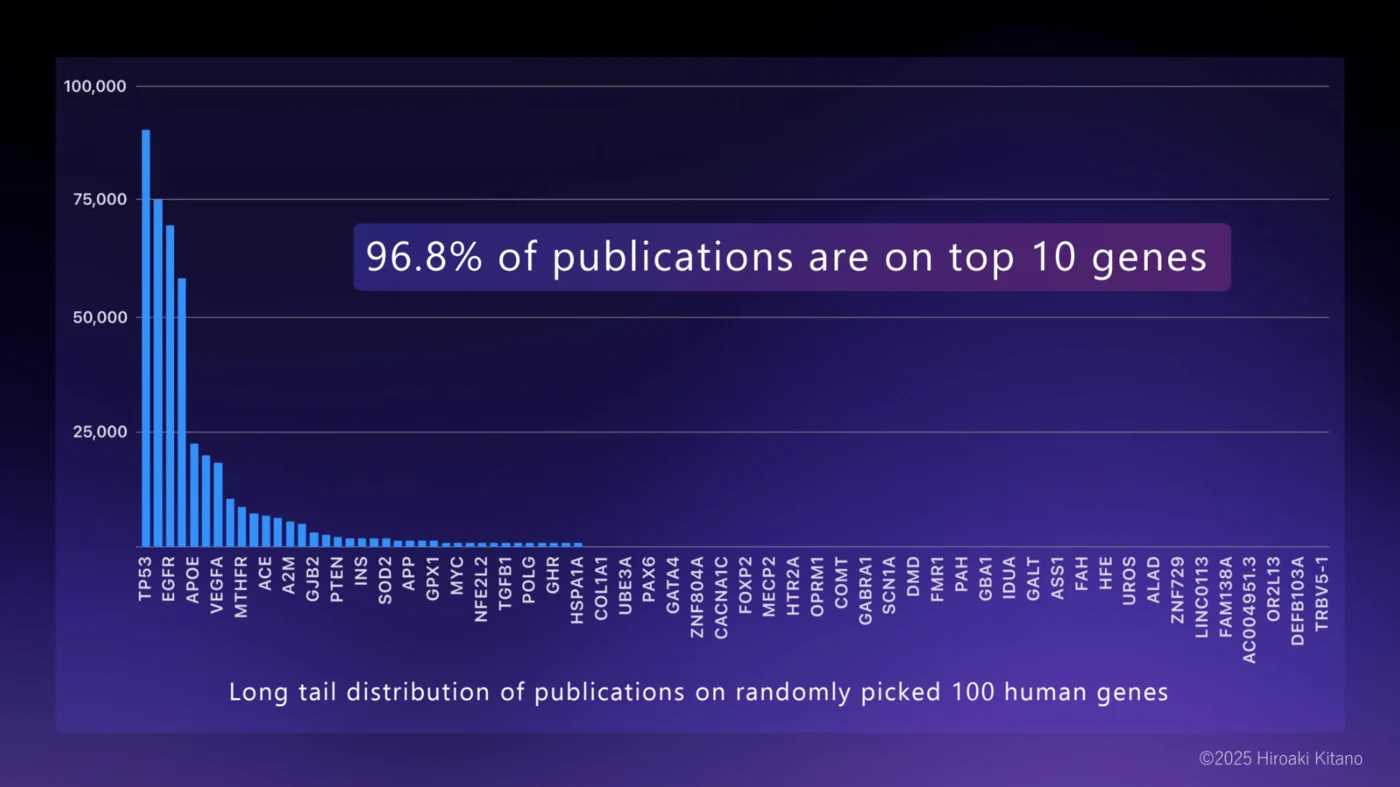
Can we build a machine that is able to make major scientific discoveries highly autonomously?
Will this machine behave like the best human scientists, or will it reveal an entirely new form of intelligence and scientific process?
The objective isn't the prize itself, but using it as a benchmark for the caliber of discovery we are aiming for.
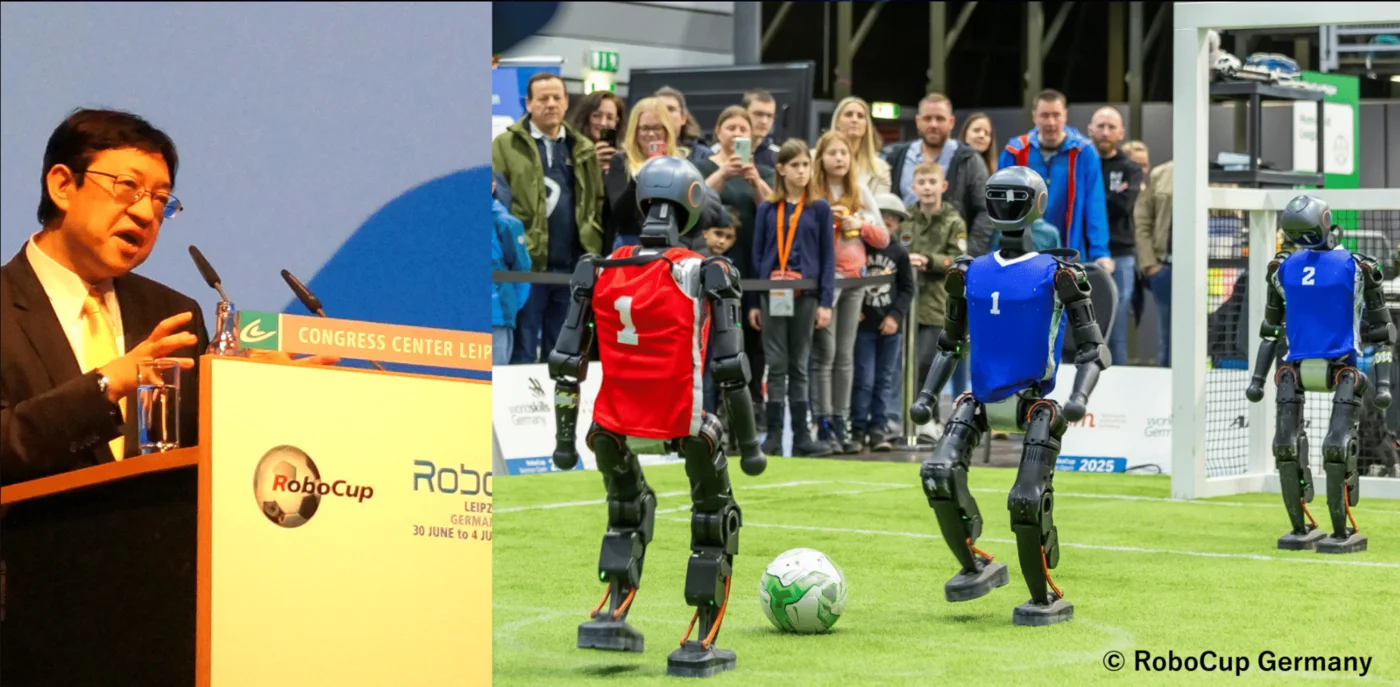
The field of AI has always been driven by grand challenges. From mastering complex board games to building autonomous soccer-playing robots, success has consistently relied on three key pillars.
"All of them will be solved by three principles. One, massive data, massive computing, and proper AI architecture."
— Hiroaki Kitano
RoboCup, a challenge to create a team of humanoid robots to win the soccer World Cup, pushes AI into the physical world, demanding agility, perception, and teamwork—all precursors to a robotic scientist.
An AI Scientist operates on a continuous, closed loop. Instead of one or two bespoke hypotheses, it generates billions, systematically testing them through automated experiments and integrating the results to build a more complete model of reality.
Trillions of Data Points
Billions of Hypotheses
Millions of Experiments
Thousands of Discoveries

The bottleneck in this automated cycle is experimentation. To run millions of experiments, we need robotic systems that can operate 24/7 with high precision and reproducibility, executing the protocols designed by the AI.
Learn more about the MANTA automated lab
Click to visit OIST press release →
Hiroaki Kitano's team at OIST in Okinawa established the MANTA Project, a fully automated multi-omics laboratory system designed to accelerate scientific discoveries through AI and robotics.
"A human scientist is successful within maybe 30 years, with limited resources. Therefore, you have to bet on a specific question. But the AI... can ask every question, and an important answer may be there to be discovered."
— Hiroaki Kitano
This marks a fundamental shift in the scientific method. Instead of relying on intuition and bias to choose what to study, an AI can explore the entire search space, uncovering connections and generating insights in areas humans would never have thought to look.
